Headlights and Headspace: The Quiet Revolution of America's Late-Night Drivers
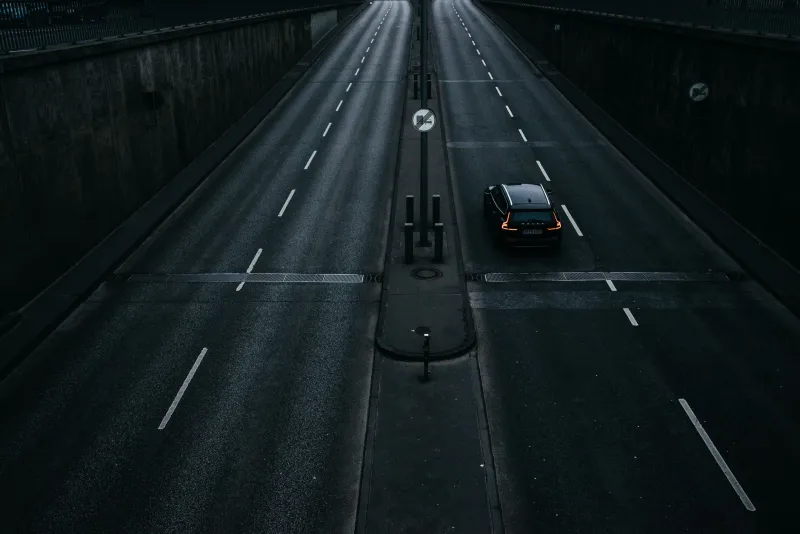
It's 1:47 a.m. on a Tuesday somewhere outside of Nashville, and Marcus Webb isn't lost. He knows exactly where he is — he's just not ready to go home yet.
"I'll drive for two hours sometimes," the 38-year-old logistics coordinator says. "No destination. Just the interstate, some low music, and my thoughts settling out like sediment in a jar." He laughs a little at his own metaphor. "I know it sounds weird. But it works better than anything else I've tried."
Marcus isn't alone. Not by a long shot.
Across the U.S., a loosely connected but unmistakably real movement of drivers has started treating the late-night road as sacred ground — a moving meditation room with cup holders. Night-shift nurses, freelance creatives, exhausted parents, and wide-awake insomniacs are all arriving at the same conclusion: there is something profoundly restorative about driving when the world has gone quiet.
What Happens When the Road Empties Out
The psychology behind it isn't as mysterious as it might seem. During the day, driving is reactive. You're responding to brake lights, construction zones, aggressive mergers, and the general chaos of shared space. Your nervous system stays on alert whether you want it to or not.
But somewhere around midnight, that dynamic flips.
Traffic thins. Signals cycle without urgency. The road opens up in a way that feels almost generous. And your brain — no longer occupied with constant micro-decisions — starts doing something different. It wanders. It processes. It lets things go.
"There's actually a neurological basis for what people are describing," says one behavioral researcher who studies routine and stress recovery. "Repetitive, low-demand physical activity — like steady highway driving — can activate the same default mode network that lights up during daydreaming and emotional processing. It's not just anecdotal. The brain genuinely uses that space."
For many night drivers, that processing is the whole point.
The Ritual Builders
Tamara Reyes works a 6 p.m. to 4 a.m. shift as a charge nurse at a hospital in the Phoenix metro area. After a hard shift — and in her line of work, most of them are — she doesn't go straight home. She drives.
"I take the 101 loop, sometimes twice," she says. "I've got a playlist that I only listen to in the car, at night. It's almost like a decompression chamber. By the time I pull into my driveway, I've left the hospital behind. If I don't do it, I bring everything inside with me — and that's not fair to my family."
Tamara's approach is deliberate and ritualized in a way that would feel familiar to anyone who's built a meaningful habit. The specific route matters. The playlist matters. Even the speed matters — she keeps it steady, never aggressive. "It's not about getting anywhere fast," she says. "It's about arriving at myself."
That phrase — arriving at myself — came up in different forms in nearly every conversation we had for this piece. There's something about the combination of movement and solitude that seems to create a particular kind of internal arrival that sitting still simply doesn't replicate.
Why Sitting Still Doesn't Always Cut It
For a lot of Americans, traditional wellness practices — meditation apps, journaling, yoga, therapy — are genuinely helpful. But they're also, for some people, frustratingly passive. You're asked to be still when your nervous system is still buzzing. You're supposed to breathe deeply when your chest hasn't fully unclenched from the day.
Driving offers something different: a task simple enough to be automatic, but engaging enough to keep the anxious mind from spiraling. It's the sweet spot between stimulation and calm.
Derek Fontaine, a 44-year-old architect in Chicago, started his late-night driving habit during the pandemic and never stopped. "I couldn't sleep. Couldn't focus. Couldn't do anything productive," he recalls. "One night I just got in the car at midnight and drove up to Evanston and back. Something about being in motion — having a direction, even a meaningless one — made me feel less trapped."
He now drives two or three nights a week. Not always late, but always alone. "My wife gets it. She says she can tell the difference in me on the days I've driven versus the days I haven't."
The Soundtrack of the Small Hours
Music, or the absence of it, plays a surprisingly important role in how night drivers describe their experience. Some prefer complete silence, finding that the ambient noise of the road — tires on asphalt, the hum of the engine — is texture enough. Others curate specific playlists that they treat almost like audio environments rather than entertainment.
What almost no one does is shuffle.
"I don't want to be surprised," says Marcus. "I want to know what's coming. The music is part of the ritual. It's not background noise — it's the atmosphere I'm building."
There's something deeply intentional about this. In an era of algorithmically generated playlists and infinite skip options, these drivers are making deliberate choices about what they hear and when. The car becomes a curated space, not just a vehicle.
The Open Road as Open Door
What strikes you most, talking to night drivers, is how consistently they describe the experience as theirs. Not a commute. Not an errand. Not dead time between obligations. Theirs.
In a culture that often treats unscheduled time as wasted time, carving out two hours at midnight to drive nowhere in particular is quietly radical. It's a refusal to be productive. It's an insistence that some things — clarity, calm, the simple act of thinking — are worth protecting.
America has always had a complicated love affair with the open road. We mythologize it in music, literature, and film. But the night drivers we spoke with aren't chasing myth. They're chasing something more personal and more immediate: the version of themselves that shows up when everything else goes quiet.
Marcus eventually pulls back into his driveway around 2:30 a.m. The neighborhood is still. He sits in the car for another minute or two — an old habit he can't quite explain — before going inside.
"It's the only time the world isn't asking anything of me," he says. "Just me and the road. That's enough. That's actually everything."