Mile Marker Wisdom: Why the Highway Teaches You Things a Therapist's Couch Never Could
The Couch You Never Have to Book
Dr. Renee Calloway has a waiting list three months long. She's a licensed therapist in Columbus, Ohio, and she'll be the first to tell you something that might sound like professional heresy: some of her clients' biggest breakthroughs didn't happen in her office.
"I can't count the number of times someone has walked in and said, 'I figured it out on the drive over,'" she laughs. "The car does something to people. It creates this moving container where the usual defenses kind of... drop."
She's not alone in noticing it. Across the country, everyday drivers are discovering what road-trippers and long-haul commuters have quietly known for decades — that the highway has a way of cracking you open. Not dramatically. Not all at once. But somewhere around the third hour of a solo drive through flat Indiana farmland or the winding stretch of US-50 through Nevada, something shifts.
The Science of Going Nowhere Fast
There's actual psychology behind what happens when you merge onto the interstate and point yourself somewhere far away. Researchers who study what's called "transient hypofrontality" — a state where the brain's analytical, self-critical regions quiet down during repetitive physical activity — have noted that driving, particularly monotonous highway driving, can trigger something close to a flow state.
In plain English: your inner critic takes a nap.
"When you're driving, especially on a familiar or simple route, your brain handles the physical task almost automatically," explains Marcus Delgado, a cognitive behavioral coach based in Austin, Texas. "That frees up mental bandwidth, but it also lowers your psychological guard. You start thinking about things you've been avoiding, and you don't have the usual anxiety to shut those thoughts down."
Delgado actually recommends long drives to some of his clients as a kind of intentional exercise. "I tell them: pick a direction, drive two hours, and just let your mind go where it wants. Don't put on a podcast. Don't call anyone. Just drive and think. The things that come up are almost always the things that matter."
What the Road Pulls Out of You
Ask around and you'll find no shortage of people who can point to a specific stretch of highway as the place where their life quietly changed direction.
Tamara Osei, a 38-year-old nurse from Charlotte, North Carolina, made the decision to leave her marriage somewhere on I-85 heading south toward Atlanta. "I wasn't even going anywhere special — just visiting my sister," she says. "But I'd been carrying this thing for two years, going back and forth in my head. And about an hour in, it just became clear. Like the road had asked me a question I finally had to answer."
She's quick to point out it wasn't a sudden emotional breakdown. It was quieter than that. More like a slow exhale.
Kevin Marsh, a 52-year-old contractor from outside of Denver, had a different kind of reckoning on a solo drive through Rocky Mountain National Park. He'd been putting off a conversation with his adult son for months — something about old resentments and a family business gone sideways. "I was just driving through that park alone, and I started talking out loud. To nobody. To myself, I guess. By the time I got to the other side, I knew exactly what I needed to say to him. And I knew I'd been the one in the wrong."
He made the call from a gas station parking lot in Granby. "Best conversation we ever had."
The Car as Confessional
There's a reason the drive-through therapy metaphor lands so well. The car offers something a therapist's office — no matter how thoughtfully decorated — simply cannot: motion. Forward motion.
"We are wired to process emotion through movement," says Dr. Calloway. "It's why people pace when they're anxious, why we walk when we need to think. Driving taps into that on a grand scale. You're literally moving through space, and your brain interprets that as progress. It makes it easier to believe that things can change."
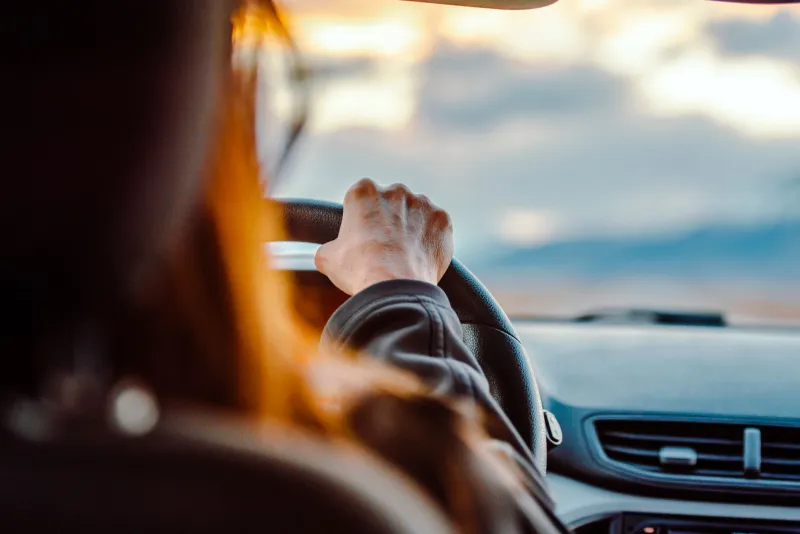
There's also the matter of privacy. No eye contact. No social performance. No one watching your face when you finally admit something to yourself. The windshield becomes a kind of one-way mirror — you can see everything ahead of you, and nobody can see in.
"My car is the only place I can actually cry without feeling embarrassed about it," one woman told us at a rest stop outside of Flagstaff, Arizona. She was on day three of a solo drive from Phoenix to see her mother in Albuquerque, a trip she takes twice a year. "I do a lot of my grief work on this road. It sounds weird, but it's true."
It doesn't sound weird at all.
Making Space for the Big Questions
Not every highway epiphany is heavy. Sometimes it's lighter than that — a career pivot that suddenly makes sense, a creative idea that wouldn't come at a desk, a realization that you've been measuring success by someone else's yardstick.
Delgado suggests that the key ingredient isn't sadness or crisis. It's space. "We live in a world that fills every silence. The car, when you let it, is one of the last places where you can actually be alone with your thoughts for an extended stretch. That's increasingly rare. And it turns out we desperately need it."
For a lot of Americans, the ritual is already there — they've just never given it a name. The Sunday afternoon drive with no destination. The long route home on a hard day. The solo road trip that was officially about visiting someone but was really about something else entirely.
Pull Over When You're Ready
If there's a takeaway from all of this, it's not that you should cancel your therapy appointments or skip the hard work of talking things through with people who love you. It's simpler than that.
Next time life feels tangled and your head feels full, maybe don't reach immediately for your phone or your playlist. Maybe just drive. Take the long way. Let the road be boring. Let your mind wander into the uncomfortable corners it's been avoiding.
The answers you've been looking for might be sitting somewhere around mile marker 47, waiting for you to get there.
And you don't even need an appointment.