Rolling Altars: The Sacred, Silly, and Deeply Personal World of Dashboard Displays
There's a woman in Albuquerque who drives a 2009 Honda CR-V with a small plastic Virgin Mary zip-tied to her air vent, a laminated photo of her late father tucked behind the speedometer, and a turquoise dreamcatcher swinging from the rearview mirror. She's not an unusual case. She's practically the norm.
Walk through any parking lot in America—from a Walmart in rural Tennessee to a marina in coastal Maine—and peer through the windshields. What you'll find isn't just a steering wheel and a cup holder. You'll find people. Their fears, their faiths, their inside jokes, and their grief, all arranged within arm's reach on four square feet of dashboard real estate.
The Dashboard as Canvas
Cars have always been more than transportation. But somewhere between the factory floor and the first oil change, something shifts. The vehicle stops belonging to the manufacturer and starts belonging to the driver. And nothing marks that transition quite like the moment someone sticks their first object on the dash.
It might be a bobblehead. It might be a crystal someone bought at a roadside stand in Sedona. It might be a St. Christopher medal that belonged to a grandfather who drove long-haul trucks through the 1970s. Whatever it is, the act of placing it there is a quiet declaration: this space is mine now.
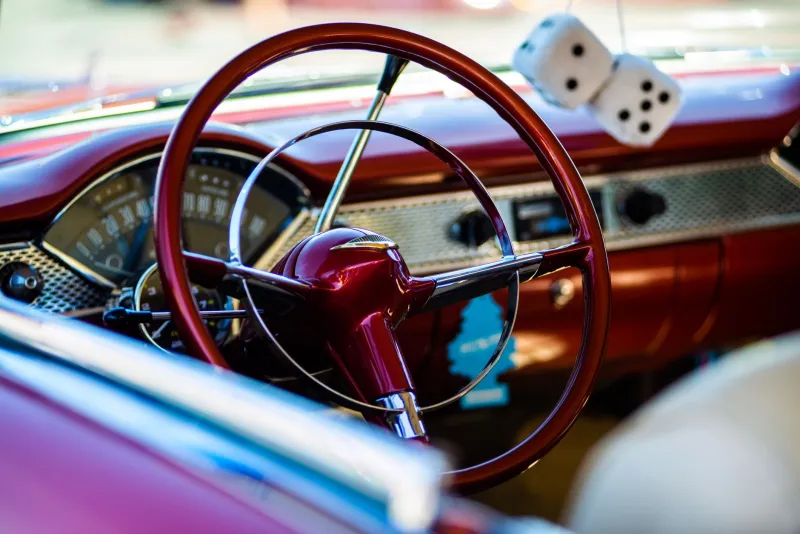
Automotive historians will tell you that dashboard ornamentation goes back almost as far as the automobile itself. Early motorists hung rosary beads from their mirrors and pinned lucky coins to their visors. The fuzzy dice—arguably the most iconic dashboard object in American car culture—first appeared in the late 1940s, popularized by returning WWII pilots who'd hung dice in their cockpits for luck during dangerous missions. They brought the habit home with them, and it never really left.
What the Objects Actually Say
There's a whole informal taxonomy to what people display, and each category carries its own weight.
Religious and spiritual items are among the most common. Crosses, saints, Hamsa hands, Buddha figurines, evil eye charms—these aren't just decoration. For many drivers, they're a genuine act of faith, a way of inviting protection into a space where danger is always a possibility. A semi driver from outside of Louisville told us he keeps a small crucifix on his dash not because he's particularly devout, but because his mother put it there before his first long haul twenty years ago. "Taking it down would feel like removing her," he said.
Family photos and mementos make up another major category. A school picture tucked into the corner of the windshield. A kid's crayon drawing held in place by the defroster vent. A sticky note in a spouse's handwriting that's been there so long the adhesive has given up. These objects turn the car into an extension of the home—a place where the people you love can ride along even when they're not there.
Lucky charms and talismans occupy a fascinating middle ground between superstition and humor. A four-leaf clover encased in resin. A rabbit's foot keychain dangling from the ignition. A specific parking garage ticket that was in the car the day nothing went wrong. Drivers are remarkably candid about these items—they'll laugh at themselves for keeping them while also making it clear they'd never dream of removing them.
Pop culture and personality items round out the collection. The Deadpool bobblehead. The miniature lightsaber. The hula dancer whose hips haven't stopped moving since 2003. These are the pieces that say something about who you are when nobody's watching—your sense of humor, your obsessions, your era.
The Psychology of the Personal Cockpit
Environmental psychologists have a term for the way humans customize their immediate surroundings: personalization behavior. It's the same impulse that drives people to decorate office cubicles or arrange their nightstand a certain way. We mark the spaces we inhabit because it helps us feel safe, grounded, and like ourselves.
The car is unique, though, because it's both intensely private and relentlessly public. You're alone in there—or nearly alone—but you're also moving through the world, visible to everyone you pass. The dashboard sits right at that intersection. Passengers see it. You see it every single time you drive. It becomes a kind of continuous, low-level conversation with yourself about who you are and what matters to you.
There's also something to be said for the ritual of it. Many drivers describe specific routines around their dashboard objects—touching a medal before merging onto the highway, glancing at a photo before a difficult workday, straightening a figurine that's shifted out of place. These small acts are grounding. They're a breath before the chaos of the road.
When the Collection Grows
Ask anyone with a well-developed dashboard display and they'll tell you: it didn't start out this way. It usually begins with one thing. Then another finds its way in. Before long, you've got a whole ecosystem going.
A retired schoolteacher in suburban Atlanta has been driving the same Buick Enclave for eleven years. Her dashboard currently features a small framed photo of her late husband, a crystal prism that throws rainbows across the interior on sunny mornings, a coin her daughter brought back from a trip to Japan, and a tiny ceramic bluebird her granddaughter painted in art class. She can tell you exactly when each item arrived and why it stayed. The whole thing reads like a timeline of her life.
"Every time I get in the car, I see all of them," she said. "It's like they're all coming with me wherever I go."
The Unspoken Rules
There's an etiquette to dashboard culture that nobody talks about but everybody seems to understand. You don't comment on someone else's display unless you're invited to. You don't move another person's objects. And if someone gives you something for your car—a charm, a photo, a little figurine—you find a place for it.
These aren't rules that were written down anywhere. They evolved organically, the way all good rituals do.
Because that's what this really is, when you strip it back. The dashboard shrine isn't about clutter or superstition or sentimentality, though it's a little bit of all three. It's about the very human need to carry your people and your meaning with you wherever the road takes you.
And honestly? That's exactly what driving has always been about.